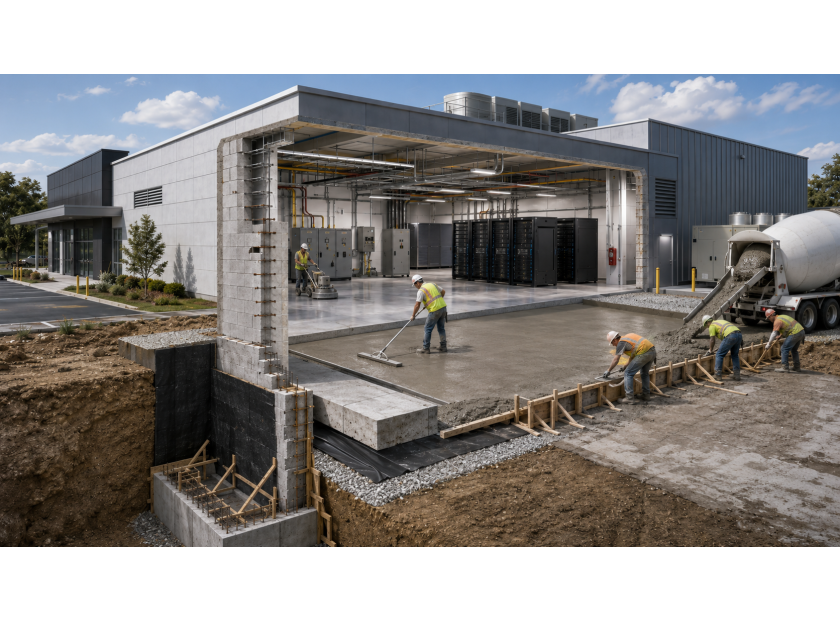
When most people picture a data center, they picture rows of servers, cooling equipment, backup generators, and miles of electrical and communication infrastructure.
They probably don't picture plate compactors, vapor barriers, concrete forms, power trowels, saw blades, joint sealants, waterproofing membranes, or safety equipment.
But long before the first server rack is installed, a data center is a construction project.
These facilities require extensive site preparation, concrete work, moisture protection, structural construction, equipment foundations, exterior improvements, and months of activity from multiple trades. Exact materials and specifications vary from project to project, but many of the processes involved rely on the same construction products and equipment contractors use every day.
That creates an important connection between the growth of data center construction and the concrete, masonry, sitework, and jobsite products available through suppliers like CMU Supply.
Data Centers Start With the Site, Not the Servers
Before a building can support critical electrical and computing infrastructure, contractors first have to create a stable site.
That can mean excavation, grading, trenching, underground utility work, aggregate base preparation, and compaction across a very large footprint.
Granular material placed beneath slabs, pavement, walkways, equipment areas, and other structures needs to be properly compacted to provide a stable foundation. Depending on the application, contractors may use forward plate compactors, reversible plate compactors, rammers, or rollers.
For smaller areas and granular base materials, plate compactors are often an efficient option. Larger sitework applications may call for heavier reversible machines or rollers that can cover more ground.
The equipment might look far removed from the technology that will eventually occupy the building, but poor site preparation can create settlement and other problems long before the facility becomes operational.
Moisture Protection Begins Below the Concrete
Once the subgrade is prepared, moisture control becomes an important consideration for many slab-on-grade applications.
Concrete itself is not an impermeable moisture barrier. Moisture vapor can migrate through slabs from the ground below, which can create problems for flooring systems, coatings, adhesives, and interior environments.
Under-slab vapor barriers help separate the concrete slab from moisture in the subgrade. These systems typically involve more than simply rolling out plastic. Seams, penetrations, edges, and transitions all need to be properly detailed.
Products such as Viper vapor barriers, Stego Wrap, vapor barrier tapes, and penetration accessories are examples of the types of materials used for under-slab moisture protection.
For a building that may eventually contain sensitive equipment and tightly controlled interior spaces, getting moisture protection right at the beginning is much easier than correcting a moisture problem after construction has progressed.
Forming the Concrete That Supports the Facility
Data centers require a tremendous amount of concrete beyond the primary building slab.
Depending on the project, contractors may be forming foundations, walls, curbs, loading areas, generator pads, equipment foundations, sidewalks, retaining structures, and other site improvements.
That work brings a much less glamorous but essential group of products into the project: concrete forming accessories.
Form ties, tie plates, form release products, expansion materials, and related accessories help contractors build and remove formwork efficiently while maintaining the dimensions required by the project.
CMU Supply carries forming products from manufacturers such as OCM, along with other concrete accessories used throughout cast-in-place construction.
They may never be visible once the building is finished, but these products play a role in creating many of the concrete structures that everything else depends on.
Building and Finishing Large Concrete Slabs
Slab construction introduces another major group of equipment.
After concrete is placed, crews need to screed, finish, cure, cut, and protect it. Larger commercial pours can require substantial coordination because each stage has to happen within the appropriate working window.
Power trowels are used to produce finished concrete surfaces efficiently. Depending on project size, crews may use walk-behind trowels, ride-on machines, float pans, and finishing blades.
CMU Supply carries concrete finishing equipment from manufacturers including Multiquip Whiteman, Allen Engineering, and Husqvarna, ranging from smaller walk-behind machines to large ride-on trowels.
Once finishing is complete, curing becomes equally important. Curing compounds, concrete blankets when temperatures require them, and other curing methods help maintain the conditions concrete needs as it develops strength.
On a major commercial project, concrete placement is not one single operation. It is an entire process supported by equipment and consumable materials before, during, and after the pour.
Cutting Joints Before the Concrete Decides Where to Crack
Concrete naturally shrinks as it cures. Control joints are intentionally introduced to help manage where cracking occurs.
For many slabs, that means saw cutting shortly after placement.
Early-entry saw systems such as Husqvarna Soff-Cut saws and blades are designed to allow contractors to cut control joints during the early stages of concrete curing. Conventional concrete saws and diamond blades may also be used for later cutting, modifications, openings, and other concrete work throughout construction.
Data center projects can continue evolving long after the initial slab is placed. Mechanical, electrical, plumbing, and structural work may require additional cutting, drilling, or surface preparation as construction progresses.
Diamond blades, concrete saws, drilling equipment, and surface preparation tools therefore remain useful well beyond the original pour.
Protecting Joints and Openings From Water
Not all moisture protection happens beneath the slab.
Exterior walls, foundations, transitions, joints, and penetrations also need protection against water intrusion.
Waterproofing membranes and air barriers such as W. R. MEADOWS AIR-SHIELD systems, along with compatible detailing products and construction sealants, can be used as part of building-envelope and below-grade moisture-control systems.
Joint sealants also serve an important role in concrete construction. Expansion joints and other moving joints need materials that can accommodate movement while limiting the entry of water and debris.
The exact waterproofing and sealant system is dictated by the project specifications, but the underlying goal remains the same: control where moisture can travel through the structure.
Masonry Still Has a Place in High-Tech Construction
A building filled with sophisticated electronics still requires walls.
Concrete masonry may be used in utility areas, mechanical rooms, service spaces, exterior structures, partitions, and other portions of commercial construction depending on the design.
That means traditional masonry accessories remain relevant.
Hohmann & Barnard ladder reinforcement, anchors, ties, flashing systems, control-joint materials, weeps, and related masonry accessories support the construction of reinforced and moisture-managed masonry assemblies.
CMU Supply also carries alternative masonry accessories from manufacturers such as 3GEN for contractors looking for products that meet project requirements.
The technologies operating inside data centers may change quickly, but many of the construction methods used to build the structures around them are familiar to masonry contractors across the industry.
Equipment Needs Its Own Concrete Too
Some of the most recognizable features of a data center are outside the server hall.
Generators, cooling equipment, transformers, electrical equipment, and other large components often require dedicated foundations, pads, or supporting concrete structures.
That creates additional forming, placing, finishing, cutting, anchoring, and repair work throughout the project.
A data center campus can therefore involve concrete work in many different locations and at many different stages rather than one large slab followed by interior construction.
Every new pad, curb, foundation, or equipment area creates another sequence of site preparation, forming, concrete placement, finishing, and protection.
Surface Preparation Continues After the Pour
Finished concrete often still needs additional work before coatings, adhesives, flooring systems, or other materials can be installed.
Grinding equipment and diamond tooling can remove coatings, address surface irregularities, prepare concrete for subsequent materials, and perform repair work as construction progresses.
CMU Supply carries concrete grinders, surface preparation equipment, diamond tooling, and dust-control accessories for these applications.
This becomes particularly important on long commercial projects where concrete surfaces may be exposed to months of construction traffic before the final space is completed.
Don't Forget the Jobsite Around the Building
Some of the products contributing to a data center project never become part of the finished structure at all.
Large commercial jobsites require PPE, hard hats, gloves, fall protection, traffic control, lighting, temporary heat, layout tools, marking products, and countless other supplies simply to keep crews working.
With multiple contractors operating at the same time, jobsite safety and organization become part of the construction process rather than an afterthought.
CMU Supply's safety and jobsite categories include products for personal protection, temporary traffic control, cold-weather work, lighting, layout, and general construction use.
A multi-year construction project can consume an enormous quantity of these everyday materials long before commissioning begins.
Where CMU Supply Products Fit Into Data Center Construction
The connection becomes easier to see when the construction process is laid out as a whole.
- Site Preparation: Reversible compactors, rammers, rollers
- Under-Slab Moisture Control: Viper vapor barriers, Stego Wrap, tapes and accessories
- Concrete Forming: OCM forming accessories, form ties, tie plates and related products
- Concrete Placement & Finishing: Power trowels, float pans, finishing blades, curing products
- Concrete Cutting: Husqvarna Soff-Cut saws, concrete saws, diamond blades
- Joint Protection: Joint sealants, expansion materials and concrete accessories
- Waterproofing: W. R. MEADOWS waterproofing and air-barrier products
- Masonry Construction: H&B reinforcement, anchors, ties, flashing, weeps and control-joint products
- Surface Preparation: Concrete grinders, diamond tooling and surface-prep equipment
- Winter Construction: Concrete blankets, heaters, lighting and cold-weather supplies
- Jobsite Safety: Hard hats, gloves, fall protection, signage and traffic-control products
No single data center project will use every product listed here, and individual project specifications determine exactly which materials are approved.
But taken together, the list illustrates something important: building a data center requires far more than servers and electrical infrastructure.
The Technology Is New. The Construction Isn't.
The rapid growth of data centers can make them seem like an entirely new category of construction.
In some ways, they are. Their electrical requirements, cooling systems, security, redundancy, and operational demands distinguish them from most traditional commercial buildings.
But contractors still have to prepare the ground, compact aggregate, form concrete, protect slabs from moisture, finish floors, cut joints, waterproof structures, build masonry, install equipment foundations, and keep hundreds of workers safe.
Those are familiar construction challenges.
And they're supported by many of the same products contractors already use every day.
CMU Supply provides concrete, masonry, moisture-control, cutting, surface-preparation, compaction, safety, and jobsite products from professional construction manufacturers for contractors working across commercial construction.
As investment in data center infrastructure continues, our role isn't to supply the servers inside the building. It's to help supply the contractors building everything around them.