
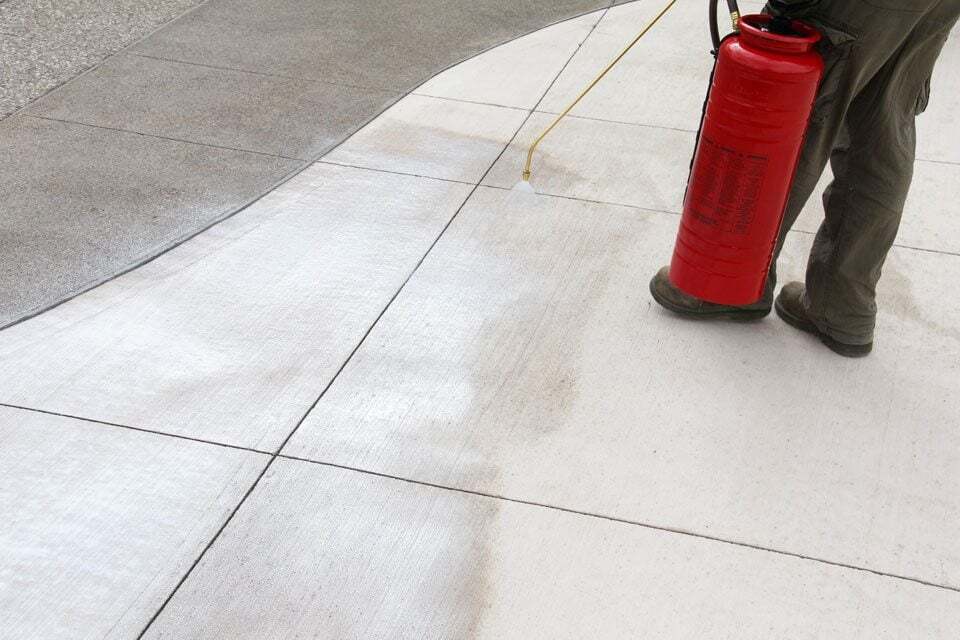
Whether you’re building a parking deck, pouring a warehouse floor, or finishing decorative concrete, choosing the right sealer can make the difference between a surface that lasts decades — and one that starts to fail after the first winter. Concrete sealers aren’t just an afterthought; they’re a critical part of protecting and preserving every concrete structure you build.
From penetrating sealers that stop water intrusion to flexible joint sealants and decorative finishes that enhance appearance, each product has a purpose. This guide breaks down the main sealer categories, how they work, and when to use them — with real jobsite context for contractors who rely on results, not just specs.
Why Seal Concrete at All?
Concrete may look solid, but it’s naturally porous. Water, chlorides, de-icing salts, and chemicals can penetrate the surface, leading to corrosion, freeze–thaw damage, and efflorescence. Once water gets in, it expands, cracks, and shortens the life of the structure. A good sealer stops that process before it starts.
Sealing also enhances long-term performance by:
- Reducing water absorption and freeze–thaw cracking
- Preventing efflorescence and surface scaling
- Protecting reinforcing steel from corrosion
- Making surfaces easier to clean and maintain
- Improving appearance and color retention on decorative concrete

Types of Concrete Sealers and Where They’re Used
Not all sealers do the same job. Some soak into the concrete to form a molecular barrier, while others create a flexible surface film or bond joints for watertight performance. Choosing the right one depends on what you’re protecting against — and where the concrete will live.
A. Penetrating Sealers – For Long-Term Protection
Penetrating sealers chemically react within the concrete to block pores and capillaries. They don’t change the surface appearance or gloss, making them ideal for exterior slabs, decks, parking structures, or architectural concrete that needs protection without a film.
- Chem-Crete PAVIX CCC 100 – A dual-crystalline, water-based sealer that forms both pore-blocking and pore-lining crystals inside the concrete. Ideal for bridges, decks, precast elements, or any surface exposed to moisture and de-icing salts.
- Brickform Stealth-Seal WB – A breathable, water-based silane/siloxane sealer that provides an invisible barrier against water, oil, and salt intrusion. Great for driveways, walkways, and masonry surfaces where you want protection without changing the natural finish.
These products are often applied after a 28-day cure and last several years before reapplication. Because they penetrate deep, they resist peeling or flaking and remain vapor-permeable — letting concrete breathe while keeping moisture out.
B. Joint, Crack & Construction Sealants – For Waterproofing and Flexibility
Joints are the most common point of failure in concrete systems. Flexible sealants protect these weak points by maintaining adhesion even when concrete expands, contracts, or moves slightly under load.
- Polylok Butyl Sealant – A precast-grade butyl sealant that remains permanently flexible and watertight. Perfect for tanks, vaults, and below-grade joints where long-term moisture resistance is critical.
- Durajoint Construction Sealant Adhesive – A one-component, low-modulus advanced polymer sealant that bonds to a wide range of substrates, even damp ones. Excellent for structural joints, siding, and concrete-to-metal transitions.
- H&B Sealant – Designed for masonry and flashing systems, this sealant provides a durable weather barrier for cavity walls and building envelopes.
Soudaflex PU35 – A professional polyurethane construction sealant for dynamic joints with high movement, UV exposure, or vibration — often used around foundations, precast panels, and expansion joints. - Stego Mastic & Viper II Mastic – Heavy-duty mastics that seal vapor barriers to footings, slabs, and penetrations. Essential for maintaining vapor control in below-slab applications.
For any joint sealant, proper prep matters as much as the product. Clean, dry surfaces, correct joint geometry, and a compatible primer (like H&B Primer SA) ensure maximum adhesion and service life.
C. Decorative & Surface Sealers – For Aesthetics and Durability
Decorative concrete finishes demand protection that enhances color and texture without dulling the look. Whether it’s stamped, stained, or integrally colored concrete, a proper sealer preserves your finish while preventing moisture or UV degradation.
- Brickform Stealth-Seal WB – Non-film-forming, breathable protection that keeps decorative concrete looking natural while repelling water and stains.
- Brickform Antique Release & Antique-It – Used during or after stamping to create authentic aged color tones that highlight texture depth and realism.
- Brickform E-Etch – A safe etching and cleaning solution that prepares the surface before applying stains or sealers, ensuring maximum adhesion and uniform finish.
For driveways, patios, and decorative overlays, combining a color treatment with a clear protective sealer gives both the look and longevity clients expect.
How to Choose the Right Sealer
| Application | Recommended Sealer | Key Benefit |
|---|---|---|
| Bridge decks, parking structures | Chem-Crete PAVIX CCC 100 | Crystalline waterproofing and chloride resistance |
| Precast or below-grade joints | Polylok Butyl Sealant | Expands on contact with moisture, long-term watertight seal |
| Masonry walls or block construction | Brickform Stealth-Seal WB | Breathable protection, prevents efflorescence |
| Decorative stamped concrete | Brickform Antique Release + Stealth-Seal WB | Adds rich tone and protects texture from wear |
| Foundation or vapor barrier sealing | Stego Mastic / Viper II Mastic | Maintains vapor control at edges and penetrations |
| General expansion and control joints | Durajoint or Soudaflex PU35 | Flexible and UV-resistant joint protection |
Application Tips for Best Results
- Clean the surface thoroughly — dust, oil, or curing residue can block penetration or bonding.
- Check moisture levels. Most sealers perform best on dry concrete with no active bleed water.
- Follow temperature guidelines — typically 40°F to 90°F for water-based products.
- Apply thin, even coats; multiple light coats outperform one heavy layer.
- Use proper joint preparation (backer rod and primer) when using flexible sealants.
- Always test a small area first, especially for decorative or colored finishes.

Common Mistakes to Avoid
- Applying film-forming sealers too early before curing is complete.
- Mixing incompatible products — for example, solvent-based over water-based without testing.
- Skipping joint prep, which leads to early adhesive failure.
- Forgetting reapplication schedules on high-traffic or UV-exposed areas.
Contractor Takeaway
Concrete sealers are not one-size-fits-all. The best product depends on your application, environment, and performance goals. Penetrating sealers like Chem-Crete PAVIX CCC 100 and Brickform Stealth-Seal WB provide long-lasting moisture resistance. Flexible joint and construction sealants such as Polylok Butyl and Durajoint handle movement and waterproofing, while decorative systems from Brickform deliver protection and visual appeal.
Whatever your next project — slab, wall, or structural pour — CMU Supply has the sealers and adhesives you need to keep it protected for the long haul.