
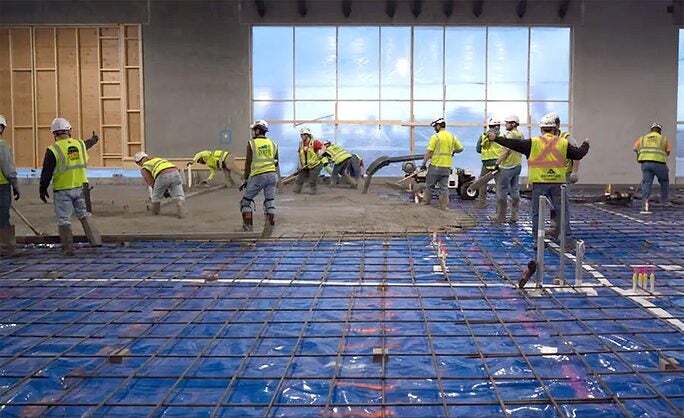
Data center construction is rapidly becoming one of the most important drivers of commercial concrete and jobsite activity in the U.S. In 2026, contractors are seeing more hyperscale projects, tighter spec tolerances, longer buildout schedules, and evolving demands for moisture control, concrete performance, and jobsite safety.
This post breaks down how data center builds are changing the way concrete and general contractors approach every phase — from subgrade prep to final fit-out — and what it means for material selection, planning, and jobsite supply.
Why Data Centers Matter to Construction Contractors
In 2025, U.S. data center construction spending surpassed $40 billion, climbing nearly 30% year over year. Individual projects now regularly exceed $200 million, with some campuses spanning multiple buildings and phases.
Unlike traditional office or retail builds, data centers are mission-critical facilities — delays, moisture issues, or safety failures can impact commissioning schedules and long-term performance. For contractors, this means:
- Higher performance expectations
- Less tolerance for rework
- Overlapping trades and compressed timelines
- Jobsites that remain active year-round
These pressures don’t just affect concrete crews — they influence how entire jobsites are supplied and managed.
Phase 1: Site Prep and Below-Grade Work
Every data center starts below grade, and early decisions can affect the project months or even years later. Subgrade prep, vapor protection, and cold-weather planning are especially critical given the scale and scheduling demands of these facilities.
Common needs at this stage include:
- Reinforced under-slab vapor barriers meeting ASTM E1745
- Tapes, accessories, and detailing materials for penetrations
- Curing blankets, heaters, and cold-weather concrete supplies
- Jobsite safety products to support large pours and heavy equipment
Mistakes at this phase are costly. Moisture intrusion or damaged vapor barriers can delay interior work and compromise sensitive environments later on.
Phase 2: Structural Slabs and Heavy Interior Concrete
Concrete plays a defining role in data center performance. These facilities often require:
- High-strength mixes (5,000–6,000 psi and up)
- Extremely flat slabs for server racks and access flooring
- Thickened slabs and equipment pads for generators and chillers
But the work doesn’t stop after placing concrete. Slabs are trafficked early and often — carts, lifts, and trades walk the surface daily, sometimes while adjacent areas are still under construction.
At this stage, contractors rely on:
- Curing and sealing compounds to lock in strength and minimize cracking
- Joint fillers and expansion joint sealants to maintain slab integrity
- Surface protection materials and peel-and-stick films
- Moisture mitigation or patching systems for touch-up and repair work
Phase 3: Interior Buildout and Environmental Control
Once the shell is complete, data center construction shifts into an extended interior buildout — a phase that can last months. It includes complex MEP installations, raised flooring systems, firestopping, and interior wall assemblies — all within a climate-sensitive environment.
Interior construction often depends on:
- Moisture control and surface prep products for adhesives and coatings
- Sealants and sound/fire-rated joint materials for interior partitions
- Firestopping sleeves and penetration protection around conduits
- Dust control, temporary protection, and containment systems
Keeping dust, moisture, and debris off sensitive surfaces becomes a critical part of the workflow — even before any servers are installed.
Phase 4: Safety, Logistics, and Ongoing Jobsite Needs
Data center jobsites are often large, multi-phase builds with dozens of contractors operating simultaneously. Safety, communication, and jobsite organization aren’t optional — they’re baseline requirements.
Contractors rely on:
- PPE, gloves, hard hats, and personal protection
- Fall protection and safety rails for multi-level work
- Temporary signage, caution tape, and cones
- Construction consumables for layout, install, and fast rework
With long project schedules and ongoing trade overlap, consistency in material supply makes a real difference in maintaining momentum and avoiding costly disruptions.
What This Means for Contractors — and CMU Supply
The data center boom represents a long-term shift in how commercial construction projects are planned and executed. These facilities demand higher standards from day one and require reliable materials through every phase of construction.
While CMU Supply doesn’t stock structural steel or mechanical systems, we support nearly every other part of the jobsite — from subgrade moisture protection and slab prep to jobsite safety and long-term floor protection.
As data centers continue to expand across the U.S., we’re focused on helping contractors stay prepared, protected, and productive — no matter how fast the technology grows.
Preparing for the Next Generation of Commercial Construction
Data centers are setting new expectations for construction performance. Contractors who succeed in this space plan earlier, protect their work throughout the project, and rely on proven jobsite materials that meet demanding specs.
CMU Supply is committed to supporting those contractors — from slab to server hall.