
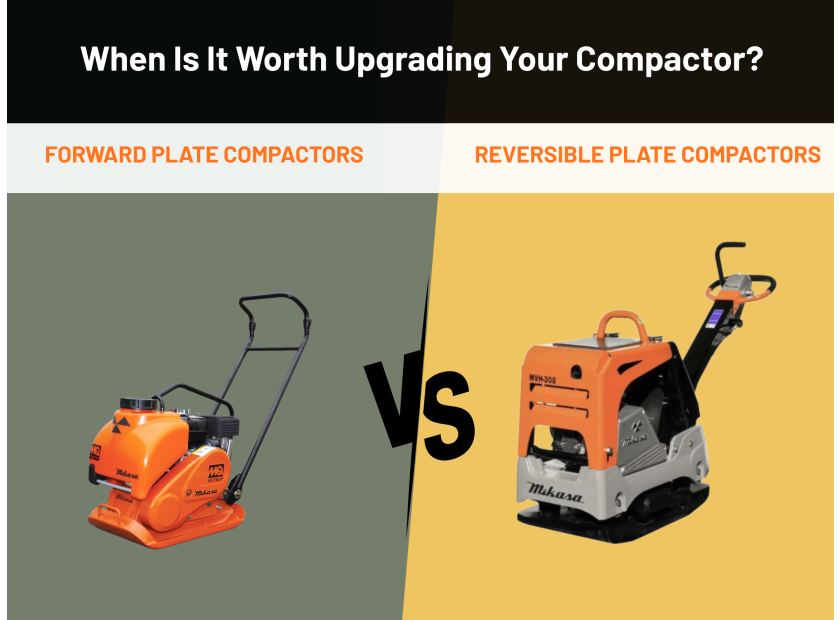
Forward plate compactors are a jobsite staple for good reason. They're relatively affordable, easy to transport, and capable of handling everything from paver bases and walkways to gravel and asphalt repairs. For many landscapers, hardscapers, and contractors, a quality forward plate is all they'll ever need.
But as projects get larger, a forward plate can start to become the limiting factor. That's where reversible plate compactors come in.
Reversible plates are heavier, more powerful, and considerably more expensive, so upgrading isn't automatically the better choice. The real question is whether the added compaction force and productivity will actually benefit the type of work your crew performs.
Here's how forward and reversible plate compactors compare, and when spending more for a reversible machine makes sense.
What's the Difference Between a Forward and Reversible Plate Compactor?
The most obvious difference is right in the name.
A forward plate compactor travels forward as it operates. To change direction or work back across an area, the operator generally needs to reposition or turn the machine.
A reversible plate compactor can travel both forward and backward. This makes it much easier to repeatedly compact the same area, work in confined locations, and maneuver a heavier machine without constantly turning it around.
But direction isn't the only difference.
Reversible plates are generally larger and heavier and can deliver substantially more centrifugal force than typical forward plates. That makes them better suited to demanding compaction work, thicker aggregate lifts, and larger jobs where production becomes increasingly important.
Where Forward Plate Compactors Make the Most Sense
For everyday landscaping and hardscaping, it's difficult to beat a forward plate compactor.
These machines are particularly effective on granular materials such as gravel, crushed stone, sand, and paver base. Their smaller size also makes them easy to maneuver around houses, walkways, landscaping, and other obstacles.
They're a natural fit for paver patios, walkways, smaller driveways, retaining wall bases, slab preparation, and similar projects. Models equipped with water tanks can also be useful for asphalt repair and patching.
Portability is another major advantage. A smaller forward plate is easier to load, unload, transport between jobs, and move around the site.
For contractors whose typical projects fall into these categories, moving to a larger reversible plate may add cost and weight without providing enough additional benefit to justify it.
Where a Reversible Plate Compactor Starts to Pay Off
The argument for a reversible plate becomes much stronger as the size and demands of the job increase.
A heavier machine with greater centrifugal force can handle more demanding compaction work and cover larger areas more efficiently. Being able to move forward and backward also allows the operator to make repeated passes without continually turning the machine around.
That becomes particularly valuable for larger base preparation, commercial site work, road construction, large retaining wall installations, and other applications where a smaller forward plate may require significantly more time and effort.
The key advantage isn't simply that a reversible plate is "better." It's production.
If a crew regularly spends hours compacting large areas with a smaller machine, increased productivity can eventually become more valuable than the lower purchase price of a forward plate.
Don't Upgrade Just Because the Reversible Plate Is More Powerful
More compaction force isn't automatically better for every application. If your crew primarily installs residential patios, walkways, or smaller hardscapes, a quality forward plate may be faster to transport, easier to maneuver, and more economical to own.
Consider the entire workflow.
A larger reversible machine has to be transported to the job, unloaded, maneuvered around the work area, and loaded again when the project is complete. If you're constantly moving between smaller residential jobs, those disadvantages can outweigh the increased compaction capability.
This is one reason forward plate compactors remain such a popular choice for landscaping and hardscaping businesses. They're powerful enough for the work while remaining practical to use every day.
When Is a Reversible Plate Compactor Worth the Money?
Instead of looking only at machine specifications, look at where your crew is spending its time.
If compaction represents a relatively small portion of each project and your current forward plate handles the material effectively, there's probably little reason to upgrade.
The calculation changes when compaction starts becoming a bottleneck. If crews regularly spend substantial time making passes across larger bases, the additional capability of a reversible plate may help complete that stage of the job faster.
The same applies if your business is moving into larger commercial work. Equipment that made perfect sense for residential patios and walkways may become inefficient when you're preparing significantly larger areas.
In that situation, the higher purchase price shouldn't be viewed in isolation. The better question is whether the larger machine can save enough labor and production time across your typical projects to justify the investment.
What About Soil Type?
Whether you're using a forward or reversible plate, the material you're compacting still matters.
Plate compactors are particularly well suited to granular materials such as gravel, crushed stone, and sand. Moving from a forward plate to a larger reversible model can provide additional compaction capability, but it doesn't change the fundamental way a plate compactor works.
For cohesive soils such as clay, a rammer may be the more appropriate choice because its concentrated impact action is better suited to that type of material.
In other words, don't use a reversible plate as an automatic solution whenever a forward plate isn't producing the results you want. First make sure a plate compactor is actually the right type of machine for the material.
Forward or Reversible: Which Should You Buy?
For landscapers, hardscapers, and contractors primarily working on residential projects, a forward plate compactor is usually the better value. It's portable, versatile, relatively affordable, and capable of handling many of the granular base materials encountered on everyday jobs.
A reversible plate compactor becomes more attractive as projects get larger and compaction requirements become more demanding. The additional force, weight, and forward/reverse operation can increase productivity enough to justify the higher investment for contractors who will actually take advantage of it.
Neither machine is universally better. The right choice comes down to the work your crew performs most often.
Find the Right Plate Compactor for Your Work
At CMU Supply, we carry forward and reversible plate compactors from professional equipment manufacturers including Multiquip Mikasa and Husqvarna, with options for everything from everyday landscaping and hardscaping to heavier commercial compaction.
If you're deciding whether it's worth moving up to a reversible plate, you don't have to make the decision based on specifications alone. Contact our team and tell us what you're compacting, the types of projects you typically handle, and how often you'll use the machine. We can help you compare your options and determine whether a forward plate still makes the most sense or whether it's time to step up to a reversible model.
Browse our selection of compaction equipment to find the right machine for your crew.