
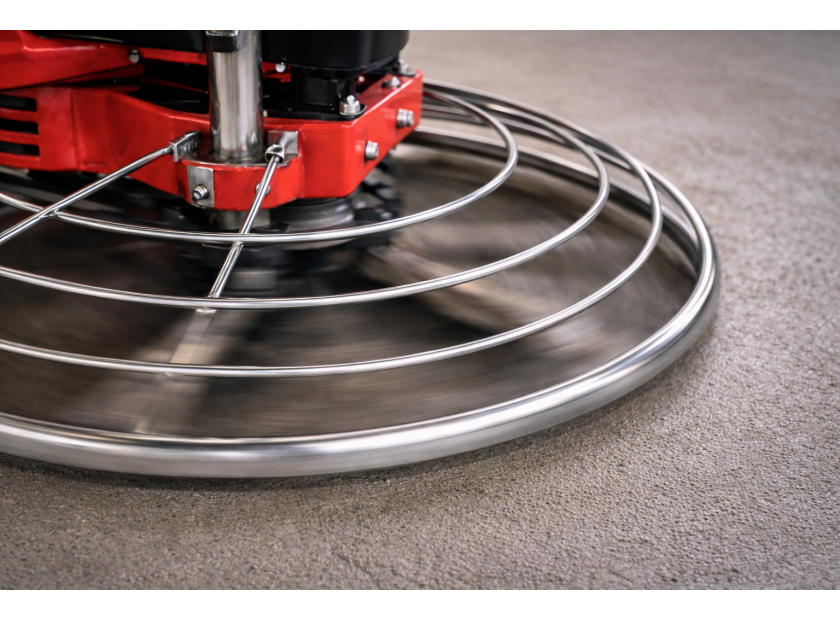
When it comes to finishing concrete slabs efficiently and to spec, power trowels are essential. But not all trowels are created equal. Selecting between a walk-behind and ride-on model can significantly impact your project’s speed, finish quality, and crew productivity.
Whether you're working on commercial slabs, warehouse floors, or smaller pours, this guide will help you understand the key differences between walk-behind and ride-on power trowels and when to choose each.
What Power Trowels Do — And Why It Matters
Power trowels smooth and level freshly poured concrete after it's been floated and before final curing. They're critical for achieving high flatness (FF) and levelness (FL) ratings, particularly on large slabs where traditional hand finishing is inefficient.
Choosing the wrong trowel for the job can mean slower work, uneven finishes, or excessive wear on both the slab and the machine.
Walk-Behind Power Trowels: Overview & Best Uses
Walk-behind trowels are single-operator machines designed for maneuverability and control. They’re often used on small to medium slabs, in tighter spaces, or on jobs where precision edging is needed.
Pros:
- Better maneuverability in confined areas
- Lightweight and easier to transport
- Great for touch-up, edging, and small to medium slabs
- Lower upfront cost
Best For:
Garage floors, sidewalks, patios, decorative slabs, and detail work around edges or obstacles.
Ride-On Power Trowels: Overview & Best Uses
Ride-on trowels are ideal for large pours where productivity and finish quality are critical. These machines allow operators to cover more ground in less time and often include dual-rotor systems for high-efficiency coverage.
Pros:
- Maximum productivity on large slabs
- Consistent, high-quality finish across wide areas
- Dual controls allow for speed and precision
- Ideal for FF/FL-spec commercial projects
Best For:
Warehouses, data centers, tilt-up construction, and large industrial slabs.
Trowel Type Recommendation by Project
| Project Type | Suggested Trowel Type |
|---|---|
| Under 1,500 sq. ft. | Walk-Behind |
| 1,500–5,000 sq. ft. | Either (based on crew size & specs) |
| Over 5,000 sq. ft. | Ride-On |
| FF/FL Critical Slabs | Ride-On (with experienced operators) |
| Tight or Detailed Areas | Walk-Behind |
Consider not just the slab size, but also crew availability, time constraints, and jobsite conditions.
Final Thoughts: What Contractors Should Know
Both walk-behind and ride-on power trowels have their place on a jobsite, and in many cases, they’re used together. Walk-behinds handle edges and transitions, while ride-ons knock out the open area with speed and consistency.
If you’re regularly bidding large-scale slabs or specs that require precision finishing, investing in a ride-on may quickly pay off. For smaller contractors or tighter pours, walk-behinds remain a go-to tool.
CMU Supply offers a range of concrete finishing tools, trowel blades, and jobsite consumables to keep your team productive and your slabs up to spec — no matter what machine you're running.